ABC Banana Bread Recipe in 10 Easy Steps for a Perfect Loaf
Preheat your oven to 350°F and grease an 8½ x 4½-inch loaf pan. Mash 1 cup of ripe bananas until mostly smooth.
Cream softened butter and sugar until light and fluffy, then whisk in dry ingredients separately. Fold the flour mix gently into the butter mixture.
Add bananas and mix-ins, and pour the batter evenly into the pan. Bake about 55–65 minutes until a toothpick comes out clean.
Let it cool before slicing for the best texture. Keep going to uncover all the baking secrets for a perfect loaf.
Key Takeaways
- Use 1 cup mashed very ripe bananas, mashing until mostly smooth with a few small lumps for optimal moisture and flavor.
- Cream softened butter and sugar until light and fluffy, then add eggs gradually, beating briefly after each addition.
- Whisk and fold dry ingredients gently into wet mixture using slow, large folding motions to avoid overmixing and preserve batter lightness.
- Grease and prepare an 8½ x 4½-inch loaf pan, scraping batter in with ½ inch headspace and tapping to release air bubbles.
- Bake at 350°F (175°C) on the middle rack for 55–65 minutes. If it’s browning too fast, tent with foil. Check doneness with a toothpick.
Preheat Oven and Prepare Loaf Pan for Banana Bread
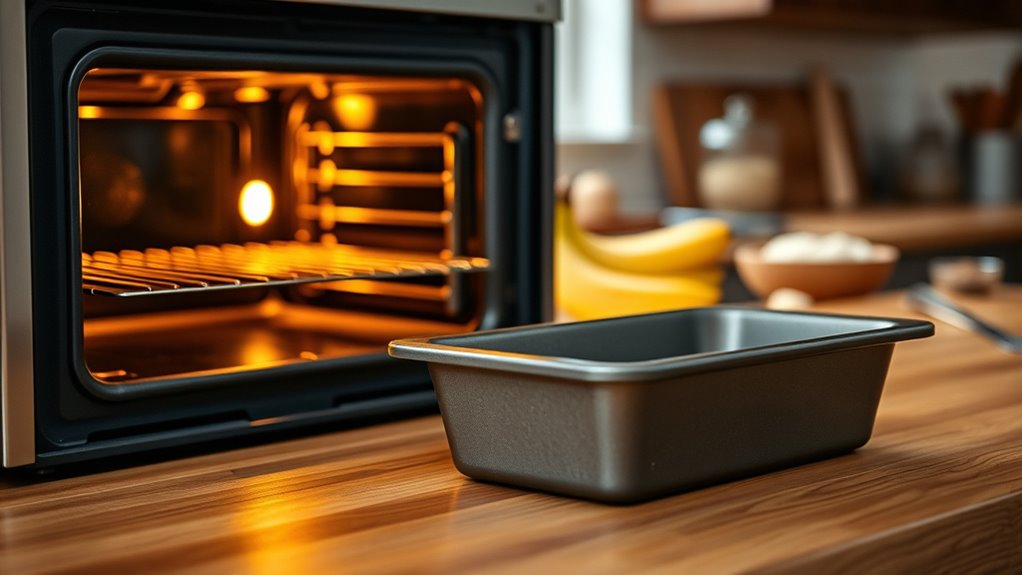
Begin by preheating your oven to 350°F (175°C) at least 10 to 15 minutes before baking. This helps make sure it reaches a stable temperature for even rising and a perfect crumb.
Preheat your oven to 350°F (175°C) well in advance for even baking and a perfect crumb.
While the oven heats, grease an 8 1/2 x 4 1/2‑inch loaf pan thoroughly with butter or nonstick spray. You can also lightly flour the pan or line it with parchment paper to guarantee easy release after baking.
If you’re using a dark or glass loaf pan, reduce the oven temperature by 25°F (10–15°C) or slightly shorten the baking time. This helps avoid overbrowning the banana bread’s crust.
Place the prepared loaf pan on the middle oven rack for even heat circulation. And if your oven has hot spots, don’t forget to rotate it halfway through baking for the best results.
Mash Ripe Bananas for Moist Banana Bread
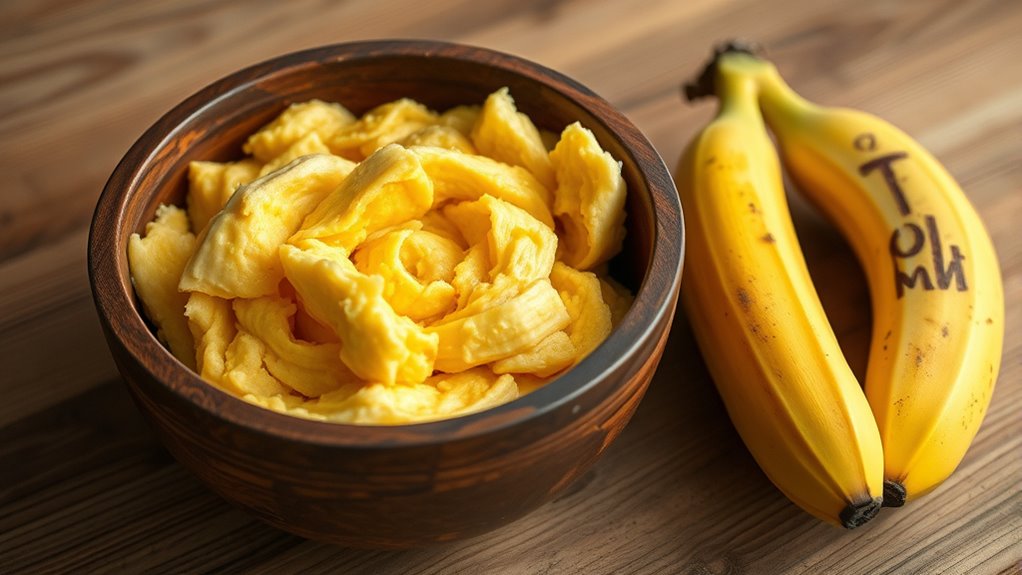
You’ll want to use very ripe bananas with plenty of brown spots for the best sweetness and moisture. Mash them thoroughly with a fork or potato masher until mostly smooth, leaving a few small lumps for texture.
Measuring one cup of mashed banana keeps your loaf moist without making the batter too wet. It’s all about finding that perfect balance!
Banana Ripeness Importance
When making banana bread, using very ripe bananas with skins heavily speckled or nearly fully brown is key to achieving moist, flavorful results. The riper the banana, the higher its sugar content and moisture, which means your bread will naturally be sweeter and softer.
Ideally, each peeled banana should weigh about 4–6 ounces. Overripe bananas, soft and dark inside, pack more natural sweetness, letting you cut back on added sugar by up to 1–2 tablespoons without losing flavor.
If you use underripe or just-yellow bananas, your bread might turn out dry and less sweet. So, you’ll need to add extra mashed banana or a bit more oil or butter to keep it moist. Measuring your mashed bananas precisely also helps maintain the right batter consistency for perfect baking.
Effective Mashing Techniques
To get the best texture for your banana bread, mash ripe bananas until they’re mostly smooth but still have a few small lumps. Use very ripe bananas with brown spots for sweeter flavor and softer flesh. About 3 medium bananas make 1 cup mashed.
Mash with a fork or potato masher, aiming for about 1 cup, loosely measured by spooning into the cup to guarantee moisture balance. For quicker, smoother mashing, microwave peeled bananas for 20–30 seconds—just don’t overheat.
When mixing, fold mashed bananas gently into the butter and eggs to keep the batter light and airy. Avoid overmixing. These effective mashing techniques will help your banana bread turn out moist with a perfect texture every time.
Cream Butter and Sugar Until Light and Fluffy
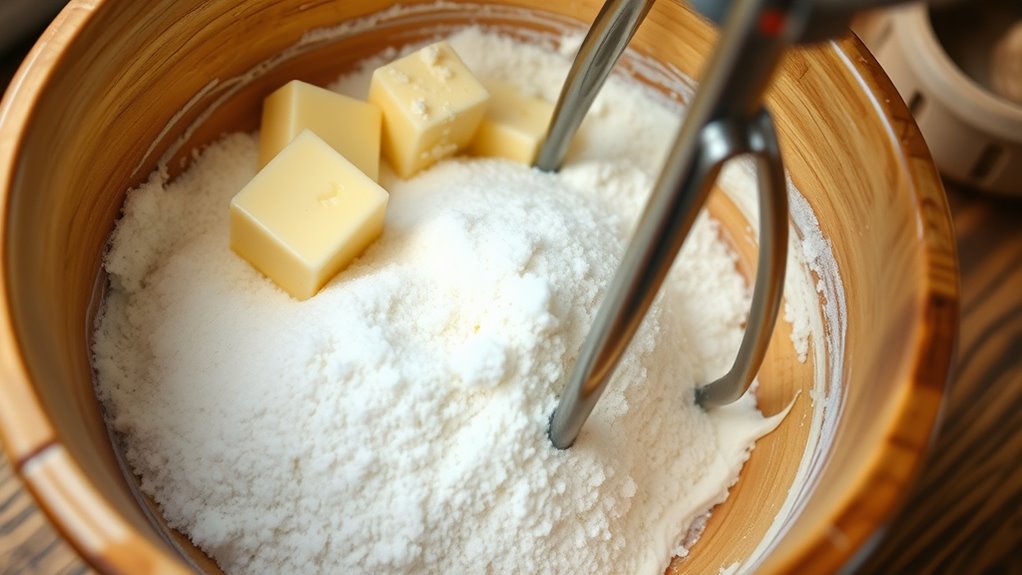
Make sure your butter is softened to room temperature—not too cold or melted—so it creams properly. Start by beating the butter and sugar together on high, scraping the bowl’s sides to mix evenly.
This step is key to creating a smooth, fluffy base for your banana bread. It really makes a difference in the texture, so don’t rush it!
Butter Temperature Tips
Although it might seem simple, achieving the perfect butter temperature is essential for creaming it properly with sugar. You want unsalted butter softened to about 65–68°F (18–20°C)—pliable enough to beat but firm enough to hold air.
Butter colder than 60°F won’t trap enough air, while butter above 75°F becomes greasy and dense, ruining your batter’s texture. Beat the butter and granulated sugar on medium-high speed for 2–3 minutes until it lightens and turns fluffy. This creates a tender, airy crumb in your banana bread.
If your butter’s too soft, chill your mixing bowl for 5–10 minutes and rewhip. If it’s too firm, soften small pieces in short, 10–15 second microwave bursts, checking often.
Also, measure softened butter by weight (5 1/3 tablespoons ≈ 75 g) for consistent results. This little step can really make a difference!
Sugar Mixing Techniques
When you cream butter and sugar together, you whip air into the mixture, creating a light, fluffy base that makes your banana bread tender. Use softened butter at about 65–70°F (18–21°C) to trap air effectively.
Start by adding granulated sugar to the butter and beat on high speed for 2–3 minutes. You’ll notice the mixture lighten in color and develop tiny air pockets, resembling light brown sugar in texture. Be sure to scrape the bowl sides frequently to mix everything evenly.
Don’t overdo it—stop once the mixture holds soft peaks and looks visibly lighter. Over-creaming, especially with very soft butter, can cause the batter to collapse, affecting your loaf’s texture. This technique guarantees a perfect crumb every time.
Whisk Dry Ingredients in a Separate Bowl
To make certain your banana bread rises evenly and has a light texture, whisk the dry ingredients—flour, salt, baking soda, and baking powder—in a separate bowl. Measure 1 1/3 cups of all-purpose flour by spooning it into the cup and leveling it to guarantee accuracy.
Use a fork or whisk to blend 3/4 teaspoon salt, 1/2 teaspoon baking soda, and 1/4 teaspoon baking powder thoroughly with the flour. Whisk for 20–30 seconds to break up lumps and aerate the flour, creating a uniform mixture without visible pockets of leavening agents.
This step helps distribute salt and leavening evenly while minimizing stirring time later. It also prevents overworking the batter and guarantees a tender crumb in your banana bread.
Fold Flour Mixture Into Butter and Sugar
Now it’s time to fold the flour mixture into your creamed butter and sugar. Use a gentle folding motion with a spatula, cutting through the center and sweeping the sides to avoid overmixing.
Aim for a batter that looks like damp brown sugar with just a few streaks of flour remaining. That’s the perfect texture you want to see.
Proper Folding Technique
After creaming the butter and sugar until light and fluffy, add the dry flour mixture all at once and fold it gently using a broad, flexible spatula. Use slow, large motions—scoop from the bottom, lift the batter, fold it over, then rotate the bowl 90 degrees each time. This guarantees even mixing without overworking the batter.
Keep these key points in mind:
- Fold just until combined—about 6–8 folds—until no dry flour streaks remain and the batter looks like damp brown sugar.
- Use a rubber spatula for flexibility and control.
- Avoid overfolding to maintain the airiness created during creaming.
Mastering this technique helps produce a light, tender loaf with perfect texture every time. It’s really worth taking the time to get it right!
Achieving Ideal Batter Texture
Achieving the ideal batter texture means folding the dry flour mixture into the creamed butter and sugar just enough to reach a coarse, damp brown sugar consistency. After creaming 5 1/3 tablespoons softened butter with 2/3 cup sugar until fluffy, add 1 1/3 cups flour, salt, baking soda, and baking powder. Use low speed or short pulses, stopping when large flour streaks disappear.
Be sure to scrape the bowl sides once or twice to mix evenly without overworking the gluten. Once this sandy texture appears, add beaten eggs and fold in 1 cup mashed bananas for moistness. If you’re using mix-ins, fold them in gently at the end.
| Step | Action | Reason |
|---|---|---|
| Cream butter & sugar | Beat 2–3 mins | Light, fluffy base |
| Add flour | Fold gently, low speed | Avoid tough gluten |
| Scrape bowl | 1-2 times | Even distribution |
| Add eggs & bananas | Fold in gradually | Preserve tenderness |
Gently Beat in Eggs to Keep Batter Light
Lightly beat the eggs until the yolks and whites are just combined, avoiding any frothy peaks to guarantee they blend smoothly without deflating the butter-sugar mixture. To keep your banana bread batter light and airy, add the eggs gradually—about one tablespoon at a time or in two small additions—beating briefly after each.
Overmixing can develop gluten and collapse the air you’ve worked hard to incorporate. Here’s how to do it right:
- Let cold eggs sit 10–15 minutes at room temperature for better emulsification.
- Beat eggs just until streaks disappear, about 10–20 seconds per addition.
- For extra tenderness, fold in the final egg addition gently with a spatula instead of beating.
This careful approach guarantees a tender, perfectly light loaf.
Add Bananas and Optional Mix-Ins
Once your eggs are gently incorporated, it’s time to add the mashed bananas. These keep the loaf moist and flavorful without overworking the gluten. Use 1 cup of mashed ripe bananas, about 2–3 medium bananas, mashing them until mostly smooth with a few small lumps for texture.
Fold the bananas gently into the batter to maintain its lightness. Next, if you’d like, add up to 3/4 cup of mix-ins like mini chocolate chips, chopped nuts, or M&Ms. Just toss dry add-ins in a tablespoon of flour first to keep them from sinking during baking.
For wet mix-ins, such as shredded coconut, reduce the mashed bananas by about 2 tablespoons. This keeps the batter’s consistency just right. Easy, right?
Pour Batter Evenly Into Prepared Pan
Scrape the batter gently into your greased 8 1/2 x 4 1/2-inch loaf pan using a rubber spatula to avoid waste and stickiness. Then, smooth the top evenly with an offset spatula or the back of a spoon. This helps the bread rise uniformly and bake evenly.
Next, tap the pan gently on the counter once or twice to release large air bubbles, preventing holes in the crumb. Remember to leave about 1/2 inch of headspace below the rim of the pan so your loaf can rise without spilling over.
If you’re adding mix-ins, fold most into the batter but reserve a few to sprinkle on top for an attractive finish. Follow these steps:
- Level batter evenly.
- Tap pan gently.
- Leave proper headspace.
Bake Banana Bread at 350°F Until Toothpick Is Clean
Preheat your oven to 350°F and place the filled loaf pan on the middle rack to guarantee even baking. Bake your banana bread for 55–65 minutes, but start checking at 50 minutes.
Use a toothpick to test doneness by inserting it into the center—it’s done when the toothpick comes out clean or with a few moist crumbs. If the top browns too fast, tent it loosely with aluminum foil.
After baking, let the loaf rest in the pan for 5–10 minutes to help the center set. This little step really helps the bread finish cooking perfectly.
| Step | Details |
|---|---|
| Oven Temperature | 350°F (175°C) |
| Baking Time | 55–65 minutes, check at 50 mins |
| Doneness Test | Toothpick comes out clean |
| Quick Browning Fix | Tent with aluminum foil |
| Resting Time After Baking | 5–10 minutes in pan |
Cool Completely Before Slicing and Serving
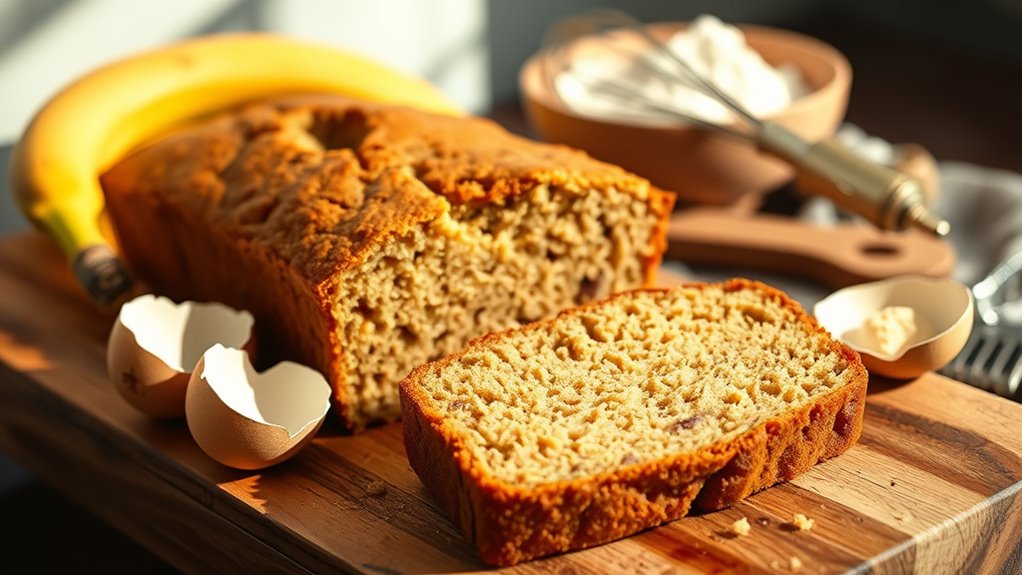
After the banana bread has rested in the pan, let it cool there for another 5–10 minutes to help the crumb set. Then, transfer the loaf to a wire rack and cool completely—this usually takes 1–2 hours for an 8½ x 4½-inch loaf.
Let your banana bread rest in the pan, then cool fully on a wire rack for perfect texture.
Cutting too soon leads to a gummy or collapsed center because moisture hasn’t redistributed. So, be patient!
For best results:
- Cool the bread fully on a wire rack to let steam escape and firm the interior.
- Chill the loaf in the refrigerator for 30 minutes to make slicing cleaner.
- Slice with a serrated knife using a gentle sawing motion.
Once cooled, store your banana bread wrapped at room temperature for up to 3 days or freeze slices for up to 3 months to maintain texture.
Easy, right? Just give it the time it needs, and you’ll get perfect slices every time.
Frequently Asked Questions
How to Make the Most Perfect Banana Bread?
To make the most perfect banana bread, use very ripe bananas. Cream butter and sugar thoroughly for that light, fluffy texture.
Fold in dry ingredients gently so you don’t overwork the batter. Bake at 350°F in a greased pan to ensure it doesn’t stick.
You’ll want to test doneness with a toothpick before cooling. If it comes out clean, you’re good to go!
Is It Better to Bake Banana Bread in a Glass or Metal Loaf Pan?
It’s better to use a metal loaf pan if you want a crisper crust and faster bake. Glass pans offer even baking and moisture but require lower heat or shorter time to avoid overbrowning, so adjust accordingly.
If you’re after a golden, crunchy outside, metal’s your go-to. But if you like your banana bread super moist and evenly cooked, glass can be a great choice. Just keep an eye on it and tweak the temperature or baking time as needed.
Is It Okay if My Banana Bread Is a Little Undercooked?
Think of your banana bread as a story; a slightly undercooked center is like an unfinished chapter—it’s safe to eat but might feel dense and gooey.
Let it rest; it’ll firm up and finish baking off the heat.
How to Make Banana Bread With Martha Stewart?
You’ll cream butter and sugar, add eggs one at a time, then mashed ripe bananas.
Fold in flour, baking soda, salt, and optional sour cream or nuts.
Bake at 350°F for about 60 minutes until done.
Conclusion
Now, as your banana bread cools, you’re holding more than just a loaf—you’re cradling warmth, comfort, and a little slice of joy. Like a well-told story, each bite unwraps memories and moments, blending sweet simplicity with rich tradition.
So, slice into this golden treasure and savor the harmony you’ve created. Remember, the perfect banana bread loaf isn’t just baked; it’s made with heart, patience, and a sprinkle of love.
Enjoy every crumb of your homemade banana bread, knowing you’ve crafted something truly special. This easy banana bread recipe brings together simple ingredients and a whole lot of flavor, making each bite a delightful experience.
Whether it’s for breakfast, a snack, or a cozy treat, your perfect loaf is ready to be enjoyed. Happy baking and bon appétit!